

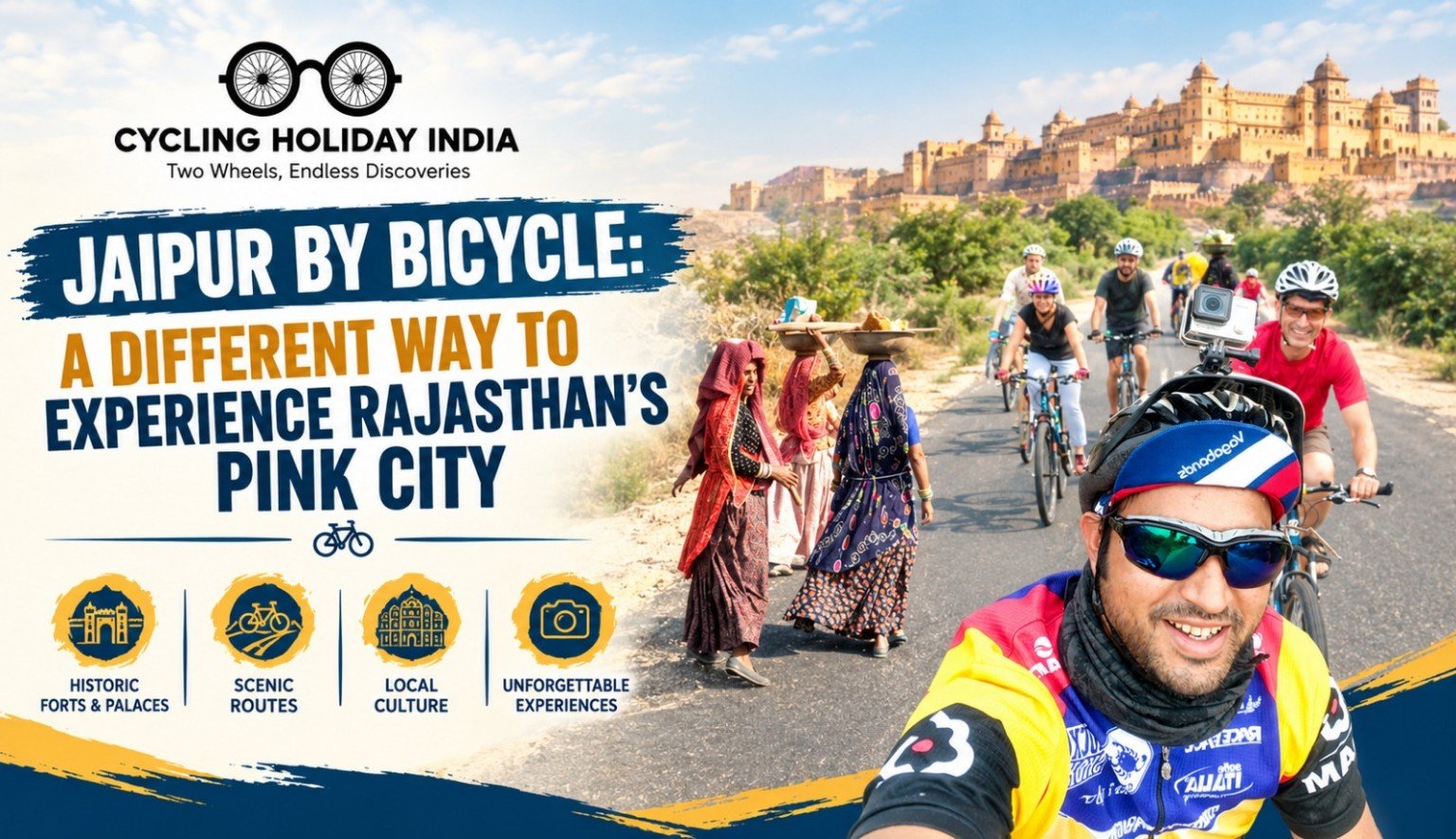
Jaipur is one of those cities that can feel familiar even before you arrive.
The Pink City appears in travel photographs, documentaries and Rajasthan itineraries around the world, with its grand forts, colourful bazaars, palaces and distinctive architecture. For many international travelers, Jaipur is also an essential stop on a first trip to Rajasthan.
But there is a different way to experience it.
By bicycle.
Instead of moving from one monument to another by car, cycling gives you the opportunity to experience the spaces between them. You notice the streets, markets, neighbourhoods, changing landscapes and small details that can easily disappear when travelling inside a vehicle.
For travelers interested in active holidays, a Jaipur cycling tour can therefore add another dimension to a Rajasthan journey.
It is not about trying to see the whole city in a few hours. It is about slowing down enough to experience Jaipur from street level while combining cycling with the history and culture that make the city special.
Why Explore Jaipur by Bicycle?
Jaipur was founded in 1727 by Maharaja Sawai Jai Singh II and is recognised by Rajasthan Tourism as India’s first planned city. Its distinctive pink appearance dates back to 1876, when the city was painted pink to welcome the Prince of Wales.
Today, the city combines historic architecture with a busy modern urban environment.
That mixture makes it particularly interesting on a bicycle.
You can move through older streets, pass colourful shops and bazaars, stop for photographs and then continue towards the larger monuments surrounding the city.
Rajasthan Tourism itself promotes cycling as a way of experiencing the state’s cities more closely, noting that bicycles allow travelers to become more connected with local streets, sounds, neighbourhoods and culture. Its Jaipur cycling suggestions include a route from Hawa Mahal towards Amber Palace and another from Amber Palace towards Nahargarh Fort.
For an international traveler, that means cycling can turn Jaipur from a list of attractions into a more complete travel experience.
Start With the Historic Pink City
A Jaipur bicycle tour can begin close to the heart of the old city.
The historic centre is where many visitors first encounter Jaipur’s distinctive architecture, colourful streets and busy markets.
Hawa Mahal is one of the city’s most recognisable landmarks. From here, cyclists can explore the surrounding streets before gradually moving towards the outskirts and the larger forts.
The advantage of cycling is the flexibility it provides.
You can stop to photograph an architectural detail, pause at a quiet street or simply observe daily life before continuing.
That is very different from a sightseeing schedule where every stop is measured by how quickly you can get from one attraction to the next.
Cycle From Hawa Mahal Towards Amber
One of the cycling routes highlighted by Rajasthan Tourism connects Hawa Mahal with Amber Palace.
The route takes travelers towards the historic Amber area and passes Man Sagar Lake, providing views of Jal Mahal along the way.
This is an interesting route because the scenery gradually changes.
You begin in the historic city environment and move towards the hills and fort landscape surrounding Jaipur.
For someone experiencing Rajasthan on a bicycle for the first time, that transition can be more memorable than simply arriving at Amber Fort by taxi.
The road becomes part of the sightseeing experience.
Jal Mahal: A Scenic Pause on the Route
Man Sagar Lake and Jal Mahal provide one of the most recognisable views around Jaipur.
The palace appears to sit within the lake, surrounded by the Aravalli landscape.
For cyclists, this area naturally creates an opportunity to pause and take photographs.
It is also a good reminder that cycling does not mean constantly being in motion.
A well-planned cycling experience should leave room for short breaks, photography and simply enjoying the surroundings.
For international travelers who are used to structured cycling holidays in Europe or North America, this slower approach can make a Rajasthan cycling experience feel very different.
Continue Towards Amber Fort
Amber Fort is one of Jaipur’s most important heritage attractions.
Rajasthan Tourism describes Amber Palace as a major attraction located on a hill about 11 kilometres from central Jaipur. The complex includes courtyards, royal quarters, gardens, temples and architectural details that reflect the history of the region.
Approaching this landscape by bicycle adds another layer to the experience.
Instead of arriving directly at the entrance after a vehicle journey, you experience the surrounding roads and hills first.
The fort itself is not simply a single building. It is a large historic complex, and travelers can spend considerable time exploring its courtyards, halls, gardens and palace spaces.
For cyclists, the combination of riding and heritage exploration makes the day more varied.
You are active for part of the day and then have time to walk through one of Rajasthan’s most significant historic sites.
What About Nahargarh and the Aravallis?
Jaipur’s northern landscape rises towards the Aravalli Hills, where Nahargarh Fort overlooks the city.
Rajasthan Tourism describes Nahargarh as sitting on a ridge of the Aravallis and notes its panoramic views across Jaipur. The fort was originally constructed in 1734 and later expanded.
For cyclists, this creates a very different experience from riding through the old city.
The terrain becomes more demanding as you move towards the hills, and the reward is the changing landscape and elevated views.
A cycling itinerary that includes hill sections should always be selected according to the rider’s fitness and experience.
That is particularly important for international travelers who may be familiar with cycling but have not ridden in Rajasthan’s climate or terrain before.
Jaipur Cycling Is Not About Racing
One misconception about cycling holidays is that you need to be a serious cyclist to participate.
That is not necessarily the case.
A well-designed bicycle tour can be about exploration rather than speed.
You may ride for part of the morning, stop for sightseeing, take photographs, enjoy local food and continue at a comfortable pace.
The objective is not to reach every destination as quickly as possible.
It is to experience the destination while moving under your own power.
This approach works particularly well for international travelers who want an active holiday without turning their vacation into a training camp.
Discover the City Beyond Its Monuments
Jaipur’s famous attractions are only one part of the experience.
The city is also known for its bazaars, crafts, textiles, jewellery and traditional food.
Cycling through the city allows you to observe these elements as part of everyday life.
A market street can be more interesting when you pass through it slowly rather than seeing it from the back seat of a vehicle.
You may notice artisans working, colourful fabrics outside shops, local transport moving through the streets or families going about their daily routines.
Of course, visitors should always be respectful when photographing people or private activities.
The aim of bicycle travel is not to turn everyday life into a spectacle. It is to travel with greater awareness of the place you are visiting.
A Different View of Jaipur’s Heritage
Jaipur is often described through its monuments, but the city’s heritage is also visible in its urban design.
The historic centre was planned with a structured layout and distinctive architecture.
The pink facades create a visual identity that continues through many parts of the old city.
Cycling lets you connect these individual elements.
Instead of thinking of Hawa Mahal, City Palace, Jantar Mantar and the forts as separate sightseeing stops, you experience how they fit into the wider geography of Jaipur.
Rajasthan Tourism’s official Jaipur information also highlights City Palace, Jantar Mantar, Hawa Mahal, Jaigarh Fort and Nahargarh Fort among the city’s major attractions.
For travelers interested in history, this connection between architecture, landscape and movement can make the city much more engaging.
How Difficult Is a Jaipur Bicycle Tour?
The difficulty depends heavily on the route.
A ride through relatively flatter parts of the city is different from cycling towards Amber or climbing into the Aravalli hills.
The distance, temperature, road conditions and amount of climbing should all be considered before choosing a route.
If you are travelling with a private group, it is also worth discussing different riders’ abilities in advance.
A group may include experienced cyclists alongside people who are more comfortable with relaxed recreational riding.
For premium supported cycling holidays, options such as support vehicles and e-bikes can provide additional flexibility on selected routes and itineraries.
That allows travelers to enjoy the cycling experience without feeling that they have to prove themselves physically.
When Is the Best Time to Cycle in Jaipur?
The cooler months are generally more comfortable for cycling in Rajasthan.
This is one reason many organised Rajasthan cycling holidays operate during the cooler part of the year.
For international visitors, weather should be considered alongside the overall itinerary.
A cycling day that feels pleasant during cooler weather can feel very different during hotter periods.
It is therefore useful to plan around the riding season rather than choosing dates based only on general sightseeing plans.
A good cycling operator can also help you understand how the expected weather fits with the route and daily distances.
Can Jaipur Be Part of a Longer Rajasthan Cycling Holiday?
Yes, and this is where Jaipur becomes especially valuable.
Rather than treating Jaipur as a standalone cycling destination, international travelers can include it within a broader Rajasthan cycling itinerary.
This allows the trip to move between very different landscapes and experiences.
You might begin around Udaipur, cycling beside lakes and through rural Aravalli landscapes. From there, a longer journey can continue towards historic towns, villages, forts and eventually Jaipur.
Another itinerary may combine Jaipur with wildlife, Agra and the Taj Mahal.
The important point is that Jaipur works naturally within a larger Rajasthan cycling holiday because it adds a strong heritage and urban component to the journey.
Why a Supported Cycling Experience Can Be Valuable
Independent cycling can be rewarding, but international travelers also need to consider logistics.
Where will your luggage stay during the ride?
What happens if the bicycle develops a mechanical problem?
How will you navigate unfamiliar roads?
Where will you stop for refreshments?
How will you move between destinations?
A supported cycling holiday can handle much of this behind the scenes.
Cycling Holiday India’s Rajasthan journeys, for example, include support vehicles, professional cycling leadership, bicycle checks, luggage transfers and mechanical support on applicable itineraries. Selected journeys also offer e-bike options.
That means the cyclist can concentrate on the actual experience instead of constantly thinking about logistics.
For someone travelling from the UK, USA, Europe, Canada or Australia, this local support can be particularly useful.
Jaipur and the Wider Rajasthan Experience
One of the strongest reasons to include Jaipur in a cycling itinerary is variety.
Rajasthan is not one single landscape.
It includes desert regions, Aravalli hills, lakes, farmland, villages, historic cities and wildlife areas.
Jaipur represents one part of that larger picture.
Its forts and planned historic city provide a strong cultural contrast to the quieter rural roads found elsewhere in Rajasthan.
This is why a Jaipur bicycle tour works best when it is treated as part of the journey rather than simply another sightseeing activity.
You ride into the city, experience its streets and heritage, and then continue towards another landscape.
What Should International Cyclists Expect?
If you are considering cycling in Jaipur for the first time, arrive with an open mind.
The experience will not necessarily feel like cycling through a quiet European cycling route.
Jaipur is a busy Indian city, and traffic, street activity and the overall pace of urban life can be very different.
That is precisely why local knowledge and experienced cycling leadership matter.
A professional team can help select appropriate roads and structure the experience around the group’s ability.
For international travelers, this can make the difference between simply renting a bicycle and taking part in a properly planned cycling experience.
Why Jaipur by Bicycle Is Worth Considering
Jaipur already has everything that attracts travelers to Rajasthan: architecture, history, colourful streets, forts, markets and a strong sense of place.
Cycling adds something different.
It allows you to connect those experiences rather than seeing them as isolated attractions.
You can ride from the historic Pink City towards Amber, pause near Jal Mahal, continue towards the fort landscape and, depending on your chosen route and ability, experience the Aravalli hills around Nahargarh.
You can also combine the cycling with local food, heritage visits and time to explore the city on foot.
For an international traveler, that creates a holiday that is active without being entirely focused on sport.
Conclusion
Jaipur by bicycle offers a different perspective on one of India’s most famous cities.
Instead of simply ticking off Hawa Mahal, Amber Fort, Jal Mahal and the other major attractions, you experience the roads and landscapes that connect them.
The city gradually gives way to lakes, forts and the Aravalli hills, creating a journey that combines movement, history and culture.
For travelers planning a wider Rajasthan cycling holiday, Jaipur can also provide an important contrast to the quieter countryside and rural landscapes found elsewhere in the state.
The key is to choose a route that matches your cycling ability and travel style, ideally with local support when exploring unfamiliar roads.
If you want to experience Rajasthan actively while still having time for heritage, food, photography and local encounters, a Jaipur cycling tour can be a memorable part of a much larger journey through the state.
FAQs
1. Is Jaipur suitable for a cycling tour?
Yes. Jaipur and its surrounding areas offer opportunities to combine city streets, heritage attractions, lakes and hill landscapes. Rajasthan Tourism specifically highlights cycling routes connecting Hawa Mahal, Amber Palace and Nahargarh.
2. Can I cycle from Jaipur to Amber Fort?
Cycling between Jaipur and the Amber area can form part of a cycling itinerary. Rajasthan Tourism highlights a route from Hawa Mahal towards Amber Palace that passes Man Sagar Lake and offers views of Jal Mahal.
3. Is cycling in Jaipur difficult for international travelers?
Difficulty depends on the route. City riding and flatter sections can be different from routes involving Amber or the Aravalli hills. Travelers should choose an itinerary based on their cycling experience, fitness and preferred daily distance.
4. Can Jaipur be included in a Rajasthan cycling holiday?
Yes. Jaipur can be combined with other Rajasthan destinations such as Udaipur, Jodhpur, Kumbhalgarh, Ranthambore and Agra, depending on the itinerary. This allows travelers to experience both urban heritage and rural cycling landscapes.
5. What are the main places to experience on a Jaipur cycling tour?
Depending on the route, a cycling experience can include the Pink City, Hawa Mahal, Jal Mahal, Amber Fort and the area around Nahargarh. Jaipur’s wider heritage attractions also include City Palace, Jantar Mantar and Jaigarh Fort.